How Much Robot Mower Do You Need? Acreage, Runtime and Charging Explained
Robot mower acreage ratings are a starting point, not a daily cutting schedule. A robot mower’s advertised acreage is a useful starting filter, but lot size and grass area are different. A machine also needs enough working time to travel between zones, return to its dock, recharge and catch up after a missed day. Compare a mower’s capacity against the actual property and schedule rather than choosing by the biggest number on a product page.
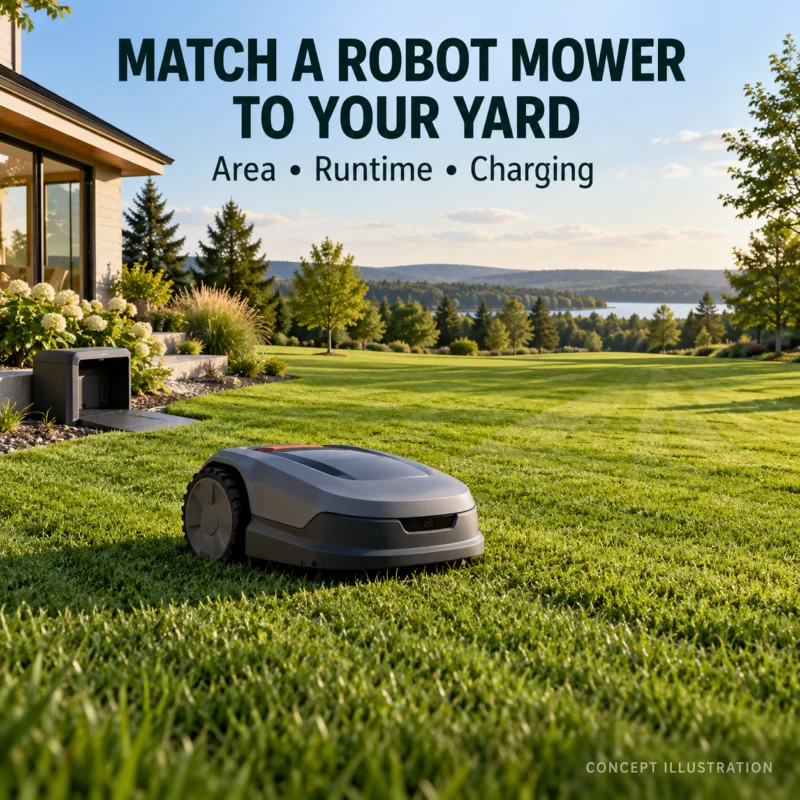
Measure mowable grass, not the deeded lot
Exclude the house, driveway, gardens, patio and sections the mower will not use. Divide the remainder into connected lawns, passages and separate zones. Record the route between zones and the charger. If an area requires carrying the mower, that is an ongoing owner task even though its square footage is included in the total.
Understand what an acreage rating means
A manufacturer may rate area under particular operating hours, grass conditions and charging assumptions. The rating does not promise that the machine can mow that acreage in a single charge. Read the model’s explanation of coverage and ask whether it assumes frequent daily operation. A yard at the upper edge of the range may leave little spare time for rain delays or unusually fast growth.
Do not automatically buy the largest model. A smaller machine with enough capacity and a suitable navigation route may fit better than a larger unit whose positioning fails in a shaded passage. Capacity and property compatibility are separate gates.
Follow the full work cycle
Record cutting width, published run time, charging time and the way the mower resumes after charging. Travel to another zone and back to the dock uses time. Slope, dense obstacles and turns can reduce effective progress. A single-charge runtime is therefore not a reliable daily acreage figure by itself.
Ask the manufacturer what happens when a scheduled window ends mid-job. Does the mower continue the next day, start again or require the owner to adjust a schedule? A mower that operates only during a limited daytime window may cover less ground than the same machine allowed to run for longer.
A property worksheet
| Input | What to enter |
|---|---|
| Mowable area | Measured grass area, not total lot size |
| Operating window | Hours mowing is acceptable each day |
| Zones | Number, size and route between them |
| Difficult terrain | Slopes, obstacles and shaded passages |
| Charging | Manufacturer figure and practical dock location |
| Buffer | Time for missed days, rain and spring growth |
Leave these inputs blank in a calculator until the visitor supplies them. A model link may populate a sourced, dated product specification or price, but every entry must remain editable. Show conservative, middle and optimistic scenarios instead of promising a precise number of square feet cut per hour without a verified basis.
Ask the dealer about a borderline lawn
How was the published coverage rating obtained? Can the mower manage every zone without manual transfer? How many working hours does the rating assume? What margin remains if the grass grows quickly after a wet week? If a narrow or shaded route is the constraint, would a higher-capacity model actually solve it? A property assessment should answer those questions before an upgrade is recommended.
See YRL’s steep-hill guide, under-trees guide and mower-versus-service comparison to evaluate the full purchase.
Frequently missed capacity questions
Does an advertised one-acre capacity mean an acre per charge? No. The area rating and battery run time describe different things. Ask how many working hours, charging periods and days underlie the published coverage. Record that answer beside the model rather than combining unrelated figures into a new promise.
What happens after several rainy days? A mower with spare scheduling capacity may catch up; one already operating at the edge of its recommended workload may not. Include a recovery buffer in the property worksheet. If grass becomes too tall for the intended robot schedule, the owner may need to cut it manually before resuming normal maintenance mowing.
Do separate zones change the needed capacity? Travel time and manual transfer can reduce useful cutting time. Sketch the actual route and ask whether the model can traverse it automatically. A large battery does not create a passage through a fence.
For a borderline decision, compare two exact models using the same lawn area, operating window and weather assumptions. If the larger model’s advantage is real under those inputs, record why. If both fail at a shaded route, solve navigation first. This keeps a mower recommendation grounded in the property rather than a simplistic rule to buy the highest advertised acreage.
Turn a rating into weekly coverage
Advertised acreage is usually a filtering number, not a promise that every lawn of that size can be completed in a chosen afternoon. First calculate only the grass that can actually be mowed. Subtract buildings, beds and inaccessible areas, then account for separately mapped zones and the travel needed between them. Next list the hours when mowing is acceptable to the household and neighbors. Compare that window with the manufacturer’s stated working pattern, charging cycle and daily operating limit for the exact model.
A mower that needs several cycles may still serve the yard if it can work across multiple days. Ask how it resumes after charging and after an interrupted schedule. On a lawn with rapid growth, a short available window may leave an untidy finish even if the theoretical acreage figure looks adequate. The relevant comparison is completed maintenance over a typical week, not a one-charge area estimate.
Check bottlenecks before upsizing
A narrow gate, steep return route or detached grass area can reduce usable capacity more than a modest increase in square footage. Map each bottleneck and ask whether the mower can pass and recover without manual carrying. Check the boundary and interior slope limits separately and how the dock is approached. If two candidate models both advertise enough acreage, the better fit may be the one that completes the actual route within the permitted schedule with a margin for rain, repairs and missed days. Do not infer that buying the largest rated model fixes an unsuitable passage or weak positioning.
In summary: Measure mowable area and available time, then check the complete mow-charge-resume cycle and routes. Choose a model with a workable schedule and margin, rather than buying exactly to a headline acreage limit.
Model-rating examples to verify: Husqvarna 435X AWD specifications and Mammotion LUBA 3 AWD variants. Their published capacities are model claims, not YRL measured coverage.