Robot Mowers and Snow Blowers for Limited Mobility: Less Work, But What’s Left?
· David
Robot mowers and snow blowers for limited mobility can reduce some of the hardest parts of maintaining a home: walking behind equipment, pushing across uneven ground, and repeatedly moving snow. But buying a robot does not automatically make yard care accessible from beginning to end.
The practical question is not simply whether a machine can mow or clear a driveway. It is whether you—or someone you can reliably call—can handle the work that remains. Grass beside a fence, snow on steps, a machine stuck beyond your reach, and seasonal maintenance all belong in the buying decision.
This guide explains the potential benefits, the overlooked chores, and how to decide whether a robot, a service, or a combination will work for your property. It is based on manufacturer documentation and practical planning considerations, not a hands-on accessibility test or a claim of medical benefit.
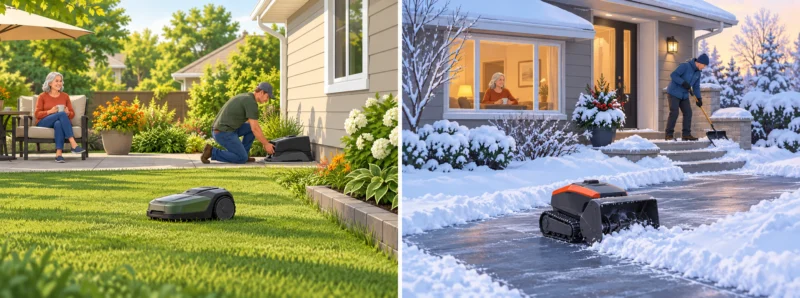
Original AI-generated editorial illustration for Yard Robot Lab. Generic equipment and conceptual scenes; not a product photograph, tested installation or technical placement guide. Exact dock clearances and operating precautions must follow the chosen model's manual.
Affiliate disclosure: Yard Robot Lab may earn a commission from purchases through paid links in this article, at no additional cost to you. Product examples are research starting points, not accessibility certifications or hands-on recommendations.
How robotic yard equipment can reduce physical work
An autonomous mower can handle routine grass cutting within its installed work area. Depending on the model and property, scheduled mowing and automatic charging can reduce how often someone needs to walk the lawn or push a conventional mower. Many mulching robot mowers leave small clippings on the lawn rather than collecting bags that need lifting and emptying.
A robotic snow blower can move snow within a mapped area without an operator continuously pushing a walk-behind blower. That may reduce a substantial part of the driveway-clearing workload.
For someone with limited walking tolerance, difficulty standing, reduced balance, or trouble handling heavy equipment, those changes may be useful. The benefit depends on which movements are difficult for that individual. A robot that replaces pushing but regularly needs lifting may solve the wrong problem.
Autonomous and remote controlled do not mean the same thing
An autonomous machine follows a configured route or work plan. A remote-controlled machine still needs someone to steer it during use. Some equipment offers both modes.
Remote control can reduce walking behind a machine, but it may still require sustained attention, hand coordination, and a suitable position from which to supervise. An app is not proof that the product supports unattended operation.
Before buying robot mowers and snow blowers for limited mobility, check the exact model's operating instructions. Yarbo's published safety guidance calls for visual supervision and an authorized, trained person supervising operation. Confirm the instructions applicable to the model and software being purchased rather than relying on broad advertising language. [1]
Will a robot mower still need edging or trimming?
Often, yes. There are two different jobs here:
- Trimming: cutting grass left beside fences, walls, trees, posts, and raised beds.
- Edging: maintaining a defined border where grass meets a sidewalk or driveway.
A mower's perimeter pass does not necessarily perform both. Its body may keep the cutting system away from a vertical obstacle, leaving a narrow strip. Newer edge-cutting systems can reduce that strip, but their effectiveness depends on the model, boundary settings, and physical layout.
Husqvarna's FAQ acknowledges that additional trimming may be needed and that fragmented lawns can require moving the mower between sections. Its EdgeCut guidance also explains that installation and mowing patterns affect the result. [2][3]
Flush paving can make a difference. STIHL explains that certain iMOW installations can cut the lawn edge where the mower can travel onto suitable level edging. That is a model-specific installation example, not permission to move every robot's boundary closer to a wall or drop. [4]
Ask a dealer to demonstrate the actual finish along your fence and sidewalk. If you cannot safely operate a string trimmer, arrange occasional help or consider suitable landscape changes. Moving the main mowing task to a robot while leaving an unmanageable perimeter chore is an incomplete solution.
Ready to research a mower?
Compare robot mowers before selecting a model. If MOVA LiDAX Ultra 1000 is on your shortlist, Check MOVA LiDAX Ultra 1000 buying options at MOVA. This buying example is not a claim that the model suits your mobility needs. Confirm the actual edge finish, installation help, recovery procedure and local service before ordering.
Will a robot snow blower leave shovel work?
It can. Plan for places the machine cannot reach or clear satisfactorily, including steps, narrow corners, door recesses, and spaces around parked vehicles. A cleared driveway also does not guarantee a usable route from the front door to the car.
Yarbo's S1 snow-preparation guide specifically tells owners to inspect for remaining snow in corners, stairways, and missed areas, then clear those places manually. The guide also includes post-storm inspection and cleaning. Those instructions directly contradict the assumption that owning a robot always eliminates finishing work. [5]
Compacted snow, plow deposits, and ice deserve separate planning. Do not assume a demonstration in fresh snow proves performance on the dense ridge left at the street. Ask what happens when the equipment cannot finish and who will clear the remaining access route.
A shovel may remain part of the household's equipment, but the person with limited mobility does not have to be the person using it. Arrange help for those tasks before the first storm.
Ready to check a snow system or module?
Check the Yarbo Y40 Core + Snow Blower Gen 2 package if you are researching a complete core-and-snow package. Check the snow module alone at Yarbo only if you already have a compatible core and have confirmed every required component. Check exact compatibility and package contents with the seller. Neither purchase removes the need to plan for steps, missed areas, supervision and physical help.
Still deciding? Explore snow-removal options and read the Yarbo core, module and bundle guide.
The overlooked task is getting a stopped robot moving again
Obstacle detection can reduce interruptions; it does not guarantee that a robot will never need help. Husqvarna describes situations where objects concealed in grass or furniture geometry can trap a mower and recommends managing those hazards. [6]
Consider the location of a possible interruption. A mower stopped on a distant slope is different from one stopped beside a level patio. A snow blower outside during a storm may require help exactly when access is hardest.
Ask the seller:
- Can common faults be resolved remotely, or must someone go outside?
- If the unit needs moving, what handling procedure does the manual require?
- What are the relevant machine and removable-component weights?
- Who can reach it, shut it down, and recover it safely?
If the recovery plan requires a lift or walk you cannot manage, budget for a helper or service. Do not make an emergency trip across slippery ground the fallback plan.
Maintenance still involves hands-on work
Robot owners may still need cleaning, blade replacement, inspection, seasonal storage, and service. The details vary by product. Husqvarna, for example, calls for regular replacement of mower blades; its cleaning instructions also differ between models. [7][8]
Judge those jobs by their movements: bending, kneeling, gripping small screws, reaching underneath equipment, or moving a machine to storage. A task described as simple may still be inaccessible to a particular owner.
For modular systems, ask who will change attachments and whether the process requires supporting or aligning heavy parts. For dealer service, ask about pickup, delivery, and seasonal availability. Include that support in the ownership cost.
Never put hands into a snow blower's chute or auger to remove a blockage. Follow the exact model's shutdown and isolation procedure and use the specified clearing tool. Yarbo's guidance requires shutdown before clearing a clogged discharge and prohibits using a hand or foot. [1]
You may need help installing the charging system
Automatic charging is a useful daily feature, but installing the system can still require hands-on help. Ask who will carry and position the dock, prepare its surface, connect the approved power equipment, arrange any required positioning hardware, and test the return-to-charge route. These jobs may involve bending, kneeling, reaching or handling components that the intended owner cannot comfortably manage.
Choose a dock location for the robot and the person. Husqvarna's placement guidance calls for a level base near power and suitable approach space; other requirements depend on the installation type. [9] Ask the installer to meet the exact model's clearances while keeping access practical for inspection and service. A dock beside the house is not automatically suitable, and a convenient electrical outlet does not settle drainage, approach or positioning requirements.
Plan the cable route before installation. Keep walking routes, wheelchair or mobility-aid access, and the machine's operating area in mind. Have the installer explain how the approved cables and connectors will be protected and routed under the manufacturer's instructions. Do not improvise a cable across an entrance or assume an ordinary extension cord is a permanent solution. If a suitable outdoor outlet is absent, arrange an assessment by a qualified electrician; new outlets or changes to fixed wiring belong with that professional. Include any electrical work in the installation quote.
Ask for a working demonstration and a handover. Have the installer show the machine leaving its dock, returning and confirming charging, along with the controls and alerts the owner will actually use. Agree who will respond if charging fails. A useful handover includes model details, support contacts and a practical plan for physical intervention rather than simply handing over an app password.
Charging can also need attention later. Some mower systems use electrical contacts that may need debris removed; Husqvarna's charging-fault guidance includes checking those contacts and the correct power equipment. [10] Other designs use different charging arrangements. Follow the exact model's safe shutdown and cleaning instructions, and arrange a helper or service visit when reaching or handling the equipment is difficult. Do not move a dock or positioning station casually: ask whether the change requires a map, installation or docking check.
An installed-and-supported package may therefore be a better fit than delivery of equipment alone. Ask what installation includes, what it excludes, and whether return visits or seasonal checks are available. Buying independence should include a plan for the day charging does not work.
Check the controls as carefully as the cutting performance
Try the app and physical controls before committing. Check text size, contrast, menu clarity, button placement, alerts, and whether the functions you need are usable with your hands and vision.
Ask whether mapping requires walking the property while steering, where the emergency stop is located, and what happens if internet service or positioning is lost. Connectivity requirements and recovery behavior vary; obtain answers for the exact configuration.
A family member setting everything up once is useful, but it does not settle who will respond to an alert next month. Make sure any shared access is supported by the manufacturer rather than sharing account credentials casually.
Compare the work left for you or a helper
This is a planning comparison, not a rating of individual models. Have the seller demonstrate the exact equipment on your property.
| Task | Robot mower | Robotic snow equipment | Before buying |
|---|---|---|---|
| Charging setup | Dock placement, cable routing and charging tests | Power, docking and seasonal setup | Who installs it and responds to charging failures? |
| Finishing work | Grass by fences, raised beds and paths; edging | Steps, door recesses, missed corners and ice | Who finishes the complete area you need usable? |
| Physical recovery | A stopped mower on rough ground or a slope | A stopped machine during a storm | Who can reach and recover the machine safely? |
| Maintenance and handling | Cleaning, blades and seasonal storage | Cleaning, storage and attachment changes where applicable | What movements and component handling are required? |
| Controls and supervision | App use, alerts and required intervention | Steering or supervision under the exact manual | Can you operate it from a suitable position and get help promptly? |
A property walkthrough before you buy
| Area to inspect | Remaining work to identify | Question to settle |
|---|---|---|
| Fences and raised beds | Uncut strips and detail trimming | Who will finish these edges? |
| Separate lawn sections | Transfers and inaccessible passages | Can the mower travel between them safely? |
| Steps and entrances | Snow removal beyond the robot's route | Who will clear the complete doorway-to-car path? |
| Driveway entrance | Dense plow deposits and leftover snow | What is the backup when the robot cannot finish? |
| Slopes and rough ground | Recovery of stopped equipment | Can a helper reach and retrieve it? |
| Charging dock, power and storage | Installation, cable routing, safe access, cleaning and seasonal handling | Who will install and test charging, and help when it fails? |
| App and controls | Setup, alerts, emergency intervention | Can the intended operator use them reliably? |
Compare the robot with the service you actually need
For some homes, robot mowers and snow blowers for limited mobility make most sense as part of a hybrid arrangement: a robot handles the recurring open-area work, while a professional or helper handles trimming, steps, maintenance, and interruptions.
Compare total costs over the same period. Include purchase, installation, property changes, consumables, connectivity charges where applicable, maintenance, storage, and paid backup. Compare that figure with quotes for a service that covers the same tasks.
Do not assume paying for less work will always produce a proportionally lower service bill. Ask whether a contractor offers finishing-only visits and how quickly they can respond during storms. A snow contractor's ability to guarantee timely access may matter more than the lowest quoted price.
Questions people commonly ask
Can a robot mower help if walking behind a mower is difficult?
Potentially. It can reduce routine mowing effort on a suitable property. Check the remaining trimming, maintenance, and recovery tasks before deciding it meets your needs.
Will I still need a weed whacker or someone to cut the edges?
Possibly. Edge-cutting features can reduce leftover grass, but fences, obstacles, and installation determine what remains. Request a demonstration rather than assuming a perfect perimeter.
Can a robot snow blower clear my steps or everything by my door?
Do not assume so. Plan separately for steps and inaccessible areas, and verify the full route you need cleared. A passable driveway alone may not provide usable access.
Will someone need to help set up the charger or docking station?
Possibly. Positioning the dock, routing its approved cables, setting up required equipment and testing charging can require bending, kneeling or carrying. Ask for an installation quote, arrange a qualified electrician if the power supply needs fixed-wiring work, and agree who will handle later charging faults.
What if I cannot lift the robot or go outside to reset it?
Arrange reliable support before buying. If no one can respond when physical intervention is necessary, a full-service contractor may be a better fit.
Choose by the work left behind
Robot mowers and snow blowers for limited mobility can be useful tools when they remove work that is difficult for the owner and the remaining chores have a workable solution.
Before purchasing, ask for a property assessment, a control demonstration, and a clear explanation of what the machine will leave unfinished. The best arrangement is the one that keeps the entire job manageable—including the day the robot needs help.
Your next step
Compare robot mowers or Explore snow-removal options. Already have a suitable shortlist? Check MOVA LiDAX Ultra 1000 buying options at MOVA or Check the Yarbo Y40 Core + Snow Blower Gen 2 package. Before paying, get an installation quote and agree who handles finishing work, maintenance and faults. Include that support in the total cost.
Manufacturer sources
- Yarbo safety guidelines
- Husqvarna Automower FAQ
- Husqvarna EdgeCut operation and installation guidance
- STIHL iMOW lawn-edge and installation guidance
- Yarbo S1 snow-preparation guide — publicly indexed text reviewed; direct retrieval returned an access error.
- Husqvarna object detection and avoidance limitations
- Husqvarna mower blade replacement
- Husqvarna robotic mower cleaning
- Husqvarna charging-station placement and installation guidance — general placement principles; follow the exact regional model manual.
- Husqvarna charging-system troubleshooting — contact-based mower example, not universal instructions for other charging designs.