Robot Mower Replacement Parts: Blades, Batteries, Chargers and Ownership Costs
Robot mower replacement parts should be chosen after identifying the exact model and the failed component. A robot mower is not a one-time purchase with zero follow-on costs. Cutting hardware wears, batteries age and charging or positioning components may need repair. The practical question is whether the owner can identify and obtain the right part for the exact model when a problem arises. Yard Robot Lab separates ordinary consumables, diagnosed repairs and optional accessories so the cost of ownership is visible.
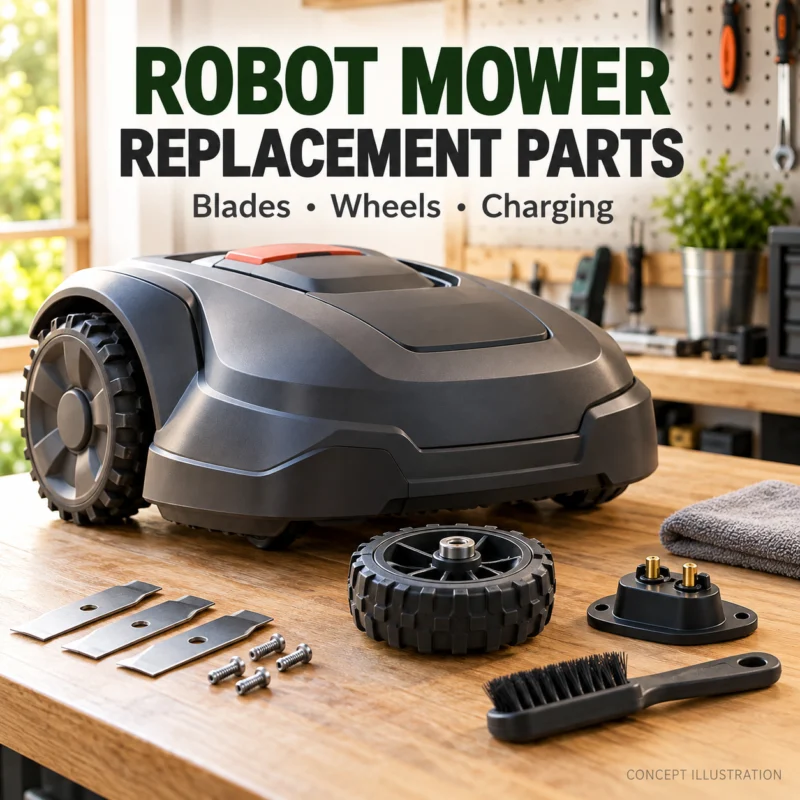
Wear is different from failure
Blades and their fasteners are expected service items. Calling them consumables does not imply that a mower is unreliable. A battery, charger, wheel or motor should not be described as failure-prone without evidence. Record the manufacturer’s inspection or replacement criterion and the source. Avoid a universal “replace every six months” table: hours, grass, sand, stones and model design affect wear.
Identify a cutting part
Check the exact model, original blade identifier, number required per change and whether screws must be renewed. A set advertised for a brand may fit only certain generations. Look up the official manual or parts catalog before linking a substitute. A low-cost blade pack that omits required hardware is not an equivalent purchase to a complete OEM kit.
Diagnose the battery and charger separately
Short runtime can follow battery aging, but it can also come from cutting-disc drag, charging contacts, a changed mowing schedule or a fault that deserves service. Record charge behavior and error messages before ordering a pack. The dock, power adapter and battery are distinct components and may have different warranty treatment. Ask whether an owner may replace the battery or needs authorized service under the specific model’s instructions.
Navigation and installation hardware
Depending on the mower, a replacement might involve boundary wire, connectors, an RTK station, antenna, cable or other positioning component. Network-delivered correction data can change the hardware and service requirements. Document the installed arrangement before assuming an accessory from a related model is interchangeable.
Minimum model-parts record
| Field | Why it belongs in a YRL model page |
|---|---|
| Exact model and generation | Prevents a brand-wide compatibility guess |
| Original part number | Identifies the documented component |
| Replacement identifier and evidence | Shows what supports any substitute |
| Inspection or replacement criterion | Distinguishes routine wear from fault diagnosis |
| Owner or service installation | Reveals labor and warranty considerations |
| Source and check date | Allows readers to verify a changing catalog |
If a part is missing from a retailer, ask the manufacturer whether the identifier was superseded or whether an authorized dealer can supply it. A dead listing does not prove that no service part exists. If the compatibility remains unknown, label it unknown and do not add a shopping button merely to keep an affiliate link.
Estimate cost without false certainty
Enter actual blade purchases, repairs, electricity and service invoices where available. A prospective buyer can use an editable maintenance allowance rather than an invented annual bill. Include shipping, labor, returns and downtime when comparing replacement options. Battery warranty and availability deserve their own ownership notes because a long mower warranty may treat components differently.
See the maintenance checklist for the inspection process and OEM-versus-aftermarket guide for comparing alternatives. The WR155 model guide shows how a model-specific page should narrow the choices.
How a model page should handle an uncertain part
Suppose an owner asks for a replacement battery and the manufacturer’s public catalog shows only a service diagram. YRL should identify the model and the diagram, say that retail availability and owner installation have not been verified, and direct the reader to the authorized service route. It should not insert a generic battery button merely because its label includes the brand. When a dealer supplies an exact part number, the site can add the verified record with its date.
What about a part advertised for multiple models? Confirm each listed model independently. A compatible blade can have broader fitment than a battery or charger; do not transfer the evidence from one category to another.
Should a parts page show prices? If displayed, use a dated source and avoid implying that a price is permanent. For total ownership, a buyer can enter their own invoice or a clearly labeled estimate. A higher-price repair may change the decision to repair or replace an aging mower, but that decision also depends on labor, availability and the machine’s condition.
These records make the model library valuable to existing owners even when a product is discontinued. They also create a defensible basis for later affiliate links without letting commission availability determine what the site calls compatible.
A decision path for a missing part number
If the model manual names a component but does not provide an orderable part number, identify the mower’s full designation, serial or generation and photograph the installed item. Search the manufacturer’s current parts diagram or ask an authorized dealer for the exact component and revision. Record the answer and whether the part is available for owner replacement or only as a service assembly. A marketplace listing with a similar photograph should remain an unverified possibility, not a recommended replacement.
A battery, charging station and power supply can produce overlapping symptoms. Separate “mower will not reach the dock,” “mower reaches the dock but does not charge” and “battery charges but runtime is short.” Follow the model’s safe diagnostic steps before buying a high-cost assembly. For a cutting problem, inspect the approved blade and disc procedure as well as the grass and schedule conditions.
Model pages that stay useful after discontinuation
Parts information is especially valuable when a mower is no longer sold. Retain the last documented SKU, manufacturer manual, parts-diagram link and the date availability was checked. Mark a discontinued model clearly while preserving ownership guidance. List a replacement as available only when the supplier can confirm it for that revision. Keep price ranges editable in an ownership calculator; one out-of-stock listing should not become a permanent expected repair cost.
In summary: A useful parts link is tied to a verified model and identifier. Diagnosis and compatibility come before purchase, whether or not a seller pays an affiliate commission.
Parts lookup examples: Husqvarna 435X AWD support and Mammotion LUBA 3 AWD accessories. These catalogs must be checked against an owner’s exact model.
TerraMow parts and accessories
Paid links: YRL may earn a commission at no additional cost to you.
The manufacturer lists separate V600 and V1000 batteries, a V-series adapter and S/V accessories. Match the exact model, region and part number; verify installation and service requirements before ordering.