OEM vs Aftermarket Robot Mower Parts: Blades, Batteries and Compatibility
OEM vs aftermarket robot mower parts is a fit and safety decision before it is a price comparison. Replacement blades, batteries and chargers are often advertised as compatible with many robot mowers. A lower price can be attractive, but fit, materials, electrical requirements and service support differ by part. The right comparison starts with the mower’s exact model and original part identifier, then asks what evidence supports a proposed replacement.
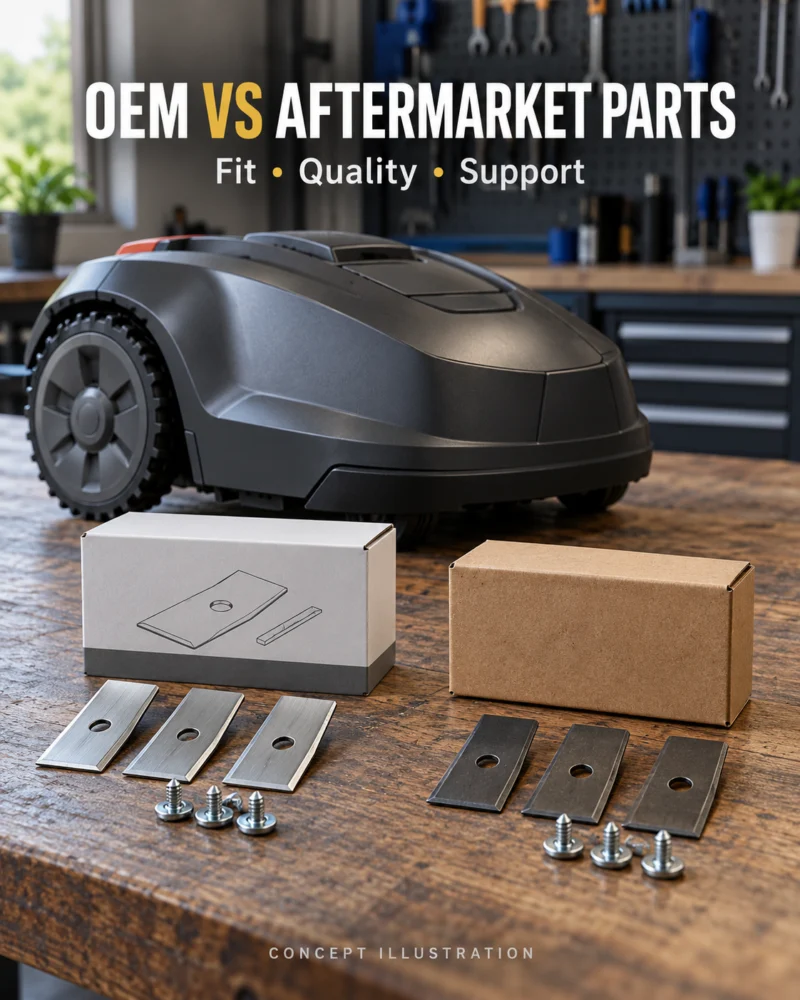
Build a compatibility record
Write down the full mower model, generation, installed part number and the replacement’s identifier. Compare the manufacturer’s catalog or manual with the seller’s compatibility statement. A product photo is weak evidence: similar-looking blades can use different screws, and similar-looking batteries can have different electrical or charging requirements.
Use three clear labels in a comparison table: manufacturer-confirmed, seller-claimed but unverified, and not supported by available evidence. Record the source and check date. Do not convert a broad marketplace title into a confirmed recommendation.
Where an alternative may make sense
An aftermarket blade can be worth investigating if a specific cross-reference exists, the correct fasteners are supplied and the owner can follow the mower’s installation instructions. Compare cost per complete change, not price per loose blade. Factor in shipping, service life and the ability to return an item that does not fit. Avoid a blanket claim that every non-OEM blade has the same performance or risk.
Batteries and chargers deserve more evidence
A battery combines physical fit with electrical and charging requirements. A charger or dock can have model and regional variations. Ask the manufacturer or an authorized service provider about the exact replacement before relying on a seller’s generic interchangeability claim. Installation may also affect the applicable warranty or require professional service. Avoid unverified battery packs, even when they are prominently marketed as compatible.
Understand warranty questions precisely
Read the actual policy for the affected mower and region. Do not assert that using any aftermarket part automatically voids the entire machine warranty. Ask instead whether damage caused by an incompatible component is covered, whether an owner repair is permitted, and which evidence is needed for a claim. Preserve packaging, receipt and installation notes until the replacement has worked normally.
Total cost includes failed attempts
| Cost | Why it matters |
|---|---|
| Part plus required hardware | Some listings omit screws or connectors |
| Shipping and return | A low item price can conceal high delivery cost |
| Labor | Some electrical or drive repairs need service |
| Downtime | A wrong part can delay mowing |
| Replacement frequency | A short-lived part can cost more over time |
Do not assume an aftermarket part is inferior, or that OEM branding alone proves a better value. Compare documented products for one model and one repair at a time. If the evidence is incomplete, show the reader how to confirm it instead of manufacturing certainty.
YRL’s link standard
Any future affiliate link on this page should lead to the exact identified item. Before publishing it, check the destination’s model compatibility, seller, identifier and availability. A search-results page is not an adequate target for a button promising a particular replacement battery. Remove or relabel a link when the listing changes. Link to the general parts guide and maintenance checklist for the diagnosis that comes before shopping.
A model-specific comparison worksheet
For each candidate, record the model and original part number, proposed replacement identifier, source of fitment evidence, included hardware, installation instructions, delivered price and return conditions. If the original listing has a complete blade-and-screw kit while the cheaper alternative contains only blades, normalize the price to one complete service change before comparing.
What if a third-party seller names a different mower generation? Request a written cross-reference to the original identifier. Keep the part unverified until that evidence arrives. A seller’s willingness to accept a return can limit financial loss but cannot establish safe electrical or mechanical compatibility.
What if an OEM item is out of stock? Check authorized dealers and ask whether the manufacturer has superseded the number. If a documented alternative exists, show it with its evidence and limitations. If not, say that no confirmed option was found. That answer serves readers better than a speculative affiliate link.
This method also applies to accessory comparisons. An optional wheel or traction kit may fit physically yet have no manufacturer support for the performance claim a seller makes. Separate verified fitment from an unverified improvement. YRL’s editorial standard should be visible beside every product recommendation.
Apply a higher evidence standard to electrical parts
A blade purchase mainly asks whether dimensions, mounting, fasteners and material match the approved cutting system. A battery or charger adds electrical and thermal requirements. Compare the manufacturer part identifier, voltage and physical connection, but do not assume a matching printed voltage is enough. Ask the manufacturer or a qualified service provider whether the control electronics, charging profile and safety protections support the specific substitute. A compatibility list from an unrelated seller is weaker evidence than current model-specific documentation.
Keep a return and fault record
Photograph the installed part and record the original symptom before replacing it. Keep the invoice, packaging, stated compatibility and any support correspondence. After installation under the approved procedure, record a normal-cycle result. If the original problem remains, the owner may need a diagnostic repair instead of another alternative part. Include return shipping and downtime in the comparison: a cheaper part that cannot be returned after a failed fit can cost more than the expected savings.
For a warranty question, read the written policy and ask whether a particular failure is attributable to the substitute, rather than assuming all coverage vanishes whenever an aftermarket part is used. Keep the answer in writing. The product page should label a part as confirmed compatible only after verification for the exact model and revision; a general “fits most robot mowers” claim should not be converted into a recommendation.
In summary: Compare evidence and total ownership cost by part category. A verified exact-match alternative can be considered; a visually similar, loosely advertised part should remain unverified until compatibility is established.
Model-level comparison sources: WORX WR155 listing and Husqvarna 435X AWD support/parts. Verify an actual aftermarket item separately before recommending it.