Best Robot Lawn Mowers for Your Yard in 2026: Five Research-Based Picks
Research-based buying guide. Specifications checked September 29, 2026; verify current model details and seller terms before buying.
The best robot lawn mower is the one that can maintain your actual grass area at your preferred cutting height and navigate the difficult parts of your yard. A half-acre rating is little help if the mower cannot handle the slope beside your driveway, reach a separate patch of lawn, or cut high enough for your grass.
Before comparing models, work through our robot mower buying questions to check drainage, obstacles, navigation, safety, maintenance, and total ownership cost.
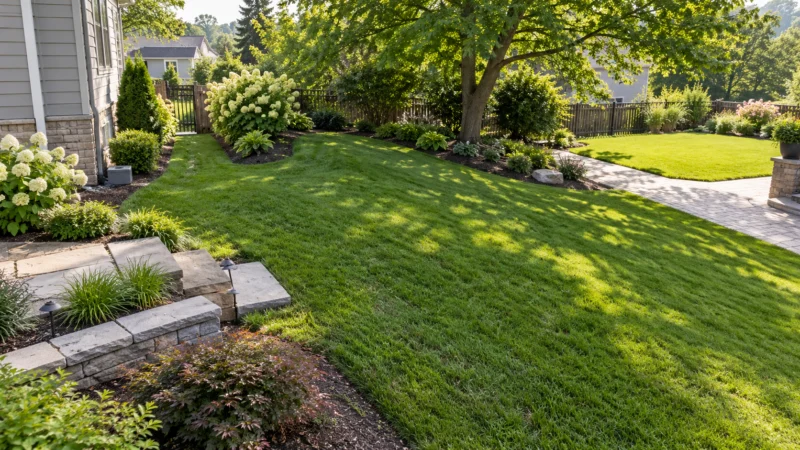
Robot lawn mower yard planning: measure the grass, check the slopes, and map how the mower will reach each lawn section.
We compared current manufacturer specifications, installation information, and documented replacement parts to choose five models for distinct situations. These are research-based recommendations. Yard Robot Lab has not field-tested these mowers, so we do not claim firsthand cut quality, obstacle avoidance, app reliability, or runtime in a particular yard.
Affiliate disclosure: Yard Robot Lab may earn a commission when you purchase through a product link, at no additional cost to you. Our recommendations are based on yard fit and published information; a commission does not make a mower suitable for your property.
Quick answer: Which mower should you look at first?
| Your situation | Start with | Published maximum grass area | Important limit to check |
|---|---|---|---|
| Small, mostly straightforward lawn | MOVA LiDAX Pro 800 | 0.2 acre | 7.9-inch cutting width and 45% maximum slope |
| Up to 0.5 acre systematic / 0.25 acre irregular; established parts and service matter | Husqvarna Automower 410iQ | 0.5 acre | Boundary slope is lower than the interior slope rating |
| Hilly lawn up to a half-acre | MOVA LiDAX Ultra 2000 AWD | 0.5 acre | Check transitions, wet traction, and the boundary |
| Steep lawn requiring a taller cut | Mammotion LUBA 3 AWD 3000H | 0.75 acre | Select the H variant, not the standard 3000 |
| Larger, complex lawn with grades and zones | MOVA LiDAX Ultra 3000 AWD | 0.75 acre per single map | Maximum coverage is not area cut on one charge |
Watch the 48-second robot mower yard-match video to see which yard conditions fit each pick.
The acreage figures are manufacturers’ rated mapping or mowing capacities. They are not independent performance measurements. Leave room below the stated maximum if the lawn has many obstacles, zones, or fast growth. We have deliberately not named a universal “best overall” mower: those five yards require different solutions.
1. Best for a small lawn: MOVA LiDAX Pro 800
Who it fits: A lawn comfortably under 0.2 acre when the owner wants a wire-free map and does not need AWD.
MOVA lists a 0.2-acre maximum mapping area, 360-degree 3D LiDAR with AI vision, rear-wheel drive, a 7.9-inch cutting width, a 1.2- to 3.9-inch cutting-height range, and a 45% maximum climbing ability. It supports multiple zones and comes with nine spare blades and screws. Those specifications make it a logical entry point for a compact lawn whose required cut height falls inside that range.
Why buy it: It offers a broad cutting-height range in a small-yard model, with no perimeter-wire installation. The included spare blades give you a starting supply for routine maintenance.
Why skip it: A half-acre yard exceeds its rating. Its relatively narrow deck also makes it an unconvincing choice when you need to maintain a larger lawn quickly. The 45% figure is a maximum climbing specification, not a guarantee on a wet or irregular slope. If a short passage or disconnected area is essential, check MOVA’s mapping rules for your exact layout before ordering.
Parts and upkeep: The package includes blades and screws. Confirm the current replacement-blade kit and compatibility when ordering more; do not assume an accessory marked for a different LiDAX series fits the Pro 800.
View the exact MOVA LiDAX Pro 800 at MOVA
2. Best when service and parts matter: Husqvarna Automower 410iQ
Who it fits: An owner with up to 0.5 acre of grass in systematic mowing or 0.25 acre in irregular mowing who values a documented support channel, manuals, and identifiable genuine replacement blades.
For US model 970727401, Husqvarna rates the 410iQ for 0.5 acre in systematic mowing and 0.25 acre in irregular mowing. Its maximum boundary slope is 15%, compared with 45% inside the installation. The mowing pattern therefore matters when choosing this model for a half-acre lawn. The 410iQ comes with a 1- to 4-inch cutting-height range and a 9.4-inch cutting width. Its EPOS setup creates virtual work areas and stay-out zones. The manufacturer lists up to 45% slope inside the installation, but its specifications give a lower maximum for the boundary. This is a meaningful distinction if a steep bank forms the edge of your lawn. Husqvarna advertises a four-year US/Canada warranty and maintains a model-specific parts and support page with blade options.
Why buy it: The 4-inch upper cut accommodates owners who maintain taller grass, and published manuals and blade listings make ongoing ownership easier to investigate before purchase. The virtual boundary can be edited when landscaping changes.
Why skip it: Do not choose it solely because “45% slope” matches a steep property; inspect the boundary and routes between work areas separately. Its 9.4-inch cutting width means a large, intricate yard may involve substantial mowing and charging time. Confirm the required positioning and connectivity arrangement at your address against Husqvarna’s current installation instructions.
Parts and upkeep: Husqvarna’s 410iQ support page lists genuine Classic and Endurance blade options and manuals. Match the mower’s product number and use the manufacturer’s compatibility list rather than buying lookalike blades on appearance alone.
View the exact Husqvarna Automower 410iQ at Amazon
3. Best for a hilly half-acre: MOVA LiDAX Ultra 2000 AWD
Who it fits: Up to 0.5 acre of grass with grades or uneven terrain that make traction a more important consideration than the lowest purchase price.
MOVA lists the Ultra 2000 AWD with four driven wheels, up to 80% maximum slope performance, dual cutting discs, and a 15.8-inch cutting width. It uses LiDAR and dual-vision navigation without a perimeter wire. The AWD model is distinct from the rear-wheel-drive Ultra 2000; their shared “2000” name is easy to misread in a shopping list.
Why buy it: The drive system and wider dual-disc deck make it a better specification match for demanding half-acre terrain than a small rear-wheel-drive mower. The manufacturer also documents replacement mower accessories, although compatibility should be confirmed by exact model.
Why skip it: If the lawn is flat, the extra drive hardware may add expense without solving a problem. An 80% maximum slope is not a promise that the machine can turn on that grade, mow safely beside a drop, or retain traction on wet grass. Map the steepest boundary and travel route, not just the steepest open patch.
Parts and upkeep: Budget for blade replacement and periodic cleaning. Before ordering a replacement disc, garage, or blade kit, check that it explicitly lists the Ultra AWD series; some MOVA accessories are marked for non-AWD Ultra models only.
View the exact MOVA LiDAX Ultra 2000 AWD at MOVA
4. Best for steep ground and a high cut: Mammotion LUBA 3 AWD 3000H
Who it fits: A yard up to 0.75 acre that needs AWD and a mowing height near four inches.
Mammotion rates the LUBA 3 AWD 3000 family for 0.75 acre and slopes up to 80%. For the 3000H, Mammotion lists a 2.2- to 4.0-inch cutting-height range; the standard 3000 is listed at 1.0 to 2.7 inches. That difference could determine whether the mower suits your grass-management plan. The 3000 family combines LiDAR, NetRTK, and vision navigation, with a dual-disc cutting system. Mammotion sells blades and discs for the LUBA 3 AWD line.
Why buy it: It pairs a high-cut option with a steep-slope specification and identifiable manufacturer replacement parts. It deserves consideration for owners who would otherwise discover too late that a standard robot mower cuts shorter than they want.
Why skip it: If you normally cut below 2.2 inches, this H variant is the wrong height range. Do not rely on the 80% number without checking the mower’s turning area, drop-offs, and terrain transitions. Verify the exact product name, package contents, and configuration on the retailer page before buying: multiple 3000 and 3000H bundles exist.
Parts and upkeep: Mammotion lists endurance blades and a LUBA 3 AWD cutting disc. Match the replacement to the precise LUBA 3 model and generation.
Search Amazon for Mammotion LUBA 3 AWD 3000H — search results only. Confirm the H variant, 2.2–4.0-inch cutting range and exact bundle before buying.
5. Best for a larger, complex lawn: MOVA LiDAX Ultra 3000 AWD
Who it fits: Up to 0.75 acre on one map, particularly where separated zones and steep sections make both mapping flexibility and AWD useful.
MOVA lists a 0.75-acre single-map area, a 15.8-inch dual-disc system, up to 80% maximum slope performance, LiDAR plus dual vision, and up to 150 zones. Its published 150- to 170-minute runtime is per charge, while the maximum mapping area describes the area it can maintain over a schedule with recharging. Do not treat those two figures as the same measurement.
Why buy it: It offers higher rated single-map coverage than the 2000 AWD, plus a drive system intended for difficult terrain. Its zone controls may help with a lawn divided by gardens, patios, or different cutting schedules.
Why skip it: More zones do not make a mower able to climb stairs, cross an inaccessible fence, or travel across a public road. If the grass is substantially smaller and level, compare lower-capacity models first. Check dock location and the passable route between zones before purchasing.
Parts and upkeep: MOVA lists robotic-mower accessories and warranty information for the US. Confirm exact AWD compatibility on replacement blades and discs rather than relying on “LiDAX Ultra” in an accessory title.
View the exact MOVA LiDAX Ultra 3000 AWD at MOVA
The five-minute yard check before you buy
- Measure only the grass. Exclude the house, driveway, beds, and wooded space from the acreage. If your lawn approaches a mower’s stated maximum, allow capacity margin rather than choosing by the lot size on a property record.
- Mark every separate area. Note gates, stairs, driveways, and narrow passages. Find out whether the mower can travel between areas on its own or whether you must carry it.
- Measure the steepest interior and boundary. Manufacturers may give separate ratings. An interior slope number alone does not qualify a mower for a steep perimeter.
- Write down your desired cutting height. Compare both ends of the specified range. The LUBA 3 AWD 3000 and 3000H, for example, serve different height preferences.
- Choose a practical dock position. Check power, a passable approach, and the model’s positioning requirements. Trees and buildings can affect some positioning systems; confirm the exact system’s installation guidance.
- Check blades, battery service, and warranty. Blades are consumables. Identify the manufacturer’s exact replacement parts and warranty terms before you order.
Questions buyers ask before spending the money
Do I need a boundary wire?
All five picks use virtual or sensor-based mapping rather than a buried perimeter wire. “Wire-free” does not mean zero setup: you still need a powered dock and must define or verify mowing boundaries, stay-out areas, and safe travel routes. The positioning hardware and connectivity requirements differ by model.
Will a robot mower cut the entire rated acreage in one charge?
Usually, the manufacturer’s acreage figure refers to an area the mower can maintain, not a promise to mow it in one battery cycle. It can recharge and resume according to its schedule. Check separate runtime, recharge, and area-per-charge specifications if completion time is important to you.
What if my backyard and front yard are disconnected?
“Multiple zones” may mean connected areas reachable along a travel path, or separate maps that require you to move the mower. Draw the route between lawns and check the exact model’s map and transport rules. A gate that stays closed or a set of steps is a practical barrier even if the app permits many zones.
Can it mow a steep hill?
Possibly, but compare grade, not degrees: an 80% grade is about 38.7 degrees, while a 45% grade is about 24.2 degrees. Those published figures are maxima under the manufacturer’s conditions. Ask whether the same rating applies at the boundary and whether the mower has room to turn and travel across the slope. No advertised grade makes an unprotected drop-off safe.
Will it cut right against walls and beds?
Do not expect any listed mower to eliminate all trimming. Deck placement, wheel path, raised edging, walls, and no-go boundaries can leave strips that still need a string trimmer. Measure the troublesome edges and look at the model’s cutting-disc position and edge-mowing guidance rather than a marketing phrase such as “edge-to-edge.”
What happens to clippings?
Robot mowers typically maintain grass with frequent small cuts and leave the fine clippings on the lawn. They are not a substitute for collecting leaves, mowing overgrown grass in a single pass, or removing branches and toys. Start with the lawn at a height within the mower’s specified cutting range.
Can it avoid pets, wildlife, toys, or dog waste?
Obstacle detection is model-dependent and cannot be assumed to identify every small or moving object. Clear toys, hoses, and waste before mowing, follow the manufacturer’s safety guidance, and consider scheduling around times when pets and wildlife use the lawn. Do not use a camera or AI feature as a safety guarantee.
Can I run it at night or in rain?
Some models advertise night operation and water resistance, but local wildlife and traction matter too. Check each model’s manual for weather limits and cleaning instructions. Avoid sending a mower onto a wet steep slope merely because its electronics can tolerate rain.
What should I budget for after purchase?
Plan for replacement blades, eventual battery service, electricity, cleaning, and any optional connectivity or accessories. Check whether advertised cellular or advanced services have a free period and what happens after it ends. We have not estimated a universal annual dollar figure because usage, blade wear, and service terms vary.
Which mower is cheapest over several years?
The lowest purchase price may not mean the lowest ownership cost. Compare the exact model’s replacement-blade price, battery and service options, warranty, any recurring connected-service fee, and the amount of manual trimming it leaves. Use Yard Robot Lab’s calculators with your current mowing cost and your own estimates; do not assume a prefilled savings number applies to your property.
How we selected these picks
We started with the problems buyers are trying to solve: area, slopes, cutting height, navigation, separate zones, parts support, and ownership costs. We checked manufacturer product and support pages and used exact-model shopping links. We excluded unsupported claims of firsthand cut quality, real-world obstacle performance, and app reliability. We may revise the list as model availability and long-term support change.
Last checked: September 29, 2026. Product options and retail bundles can change; verify the exact model and included equipment at checkout.