Thinking About a Robot Mower? Questions to Ask Before You Buy
· David
Getting your weekends back sounds appealing. So does seeing a neatly maintained lawn without spending Saturday pushing a mower. But before buying a robot mower, you need to answer a practical question: will it work well in your particular yard?
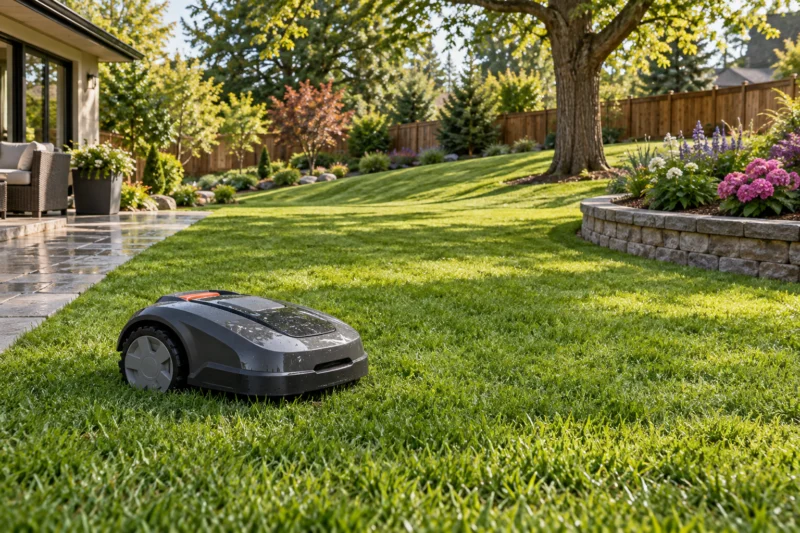
Featured artwork: original illustration for YardRobotLab; the mower does not represent a specific manufacturer’s model.
Lawn size matters, but so do drainage, trees, slopes, exposed roots, narrow passages, and the way your family uses the space. A suitable mower can reduce routine mowing work. An unsuitable one can leave you troubleshooting, carrying it between areas, or finishing more grass than expected.
Here are the questions to consider before placing an order.
Find and compare robot mowers for your yard.
1. Will a robot mower work in my yard?
Walk your property before shopping. Look at the actual mowing area, not simply your lot size.
Identify slopes, tight corners, narrow passages, disconnected lawn sections, exposed roots, and low spots that collect water. Note fences, raised beds, ponds, and places where the mower could encounter a drop-off.
Also consider the charging station. It needs a location that meets the model’s requirements for power, access, ground conditions, and connectivity.
Your first buying question should be: “Can this mower safely reach and maintain every section I expect it to cut?”
2. How much mowing capacity do I need?
Measure the grass area, excluding buildings, driveways, patios, and planting beds.
Then examine the manufacturer’s coverage rating alongside the operating schedule. Ask how many mowing hours the machine needs to maintain that area and whether those hours fit your household.
A mower that needs to run whenever the children want to play outside may be a poor match, even if its acreage rating looks sufficient. Allow flexibility for weather interruptions and periods of faster growth.
3. Should I choose boundary wires or a wire-free system?
Both approaches deserve consideration. Wire-free does not automatically mean better, and a boundary wire does not automatically mean outdated.
| System | Potential advantages | Things to consider |
|---|---|---|
| Physical boundary wire | Defines the working perimeter without depending on satellite reception to establish that boundary | Installation work, wire faults, and adjustments when landscaping changes |
| Satellite-based virtual boundaries, often using RTK | App-based boundaries and flexible zone changes | Sky visibility, antenna or correction-service requirements, and connectivity needs |
| Camera or LiDAR-based navigation | Some models operate without a perimeter wire or satellite reference station | Model-specific requirements for mapping, surroundings, lighting, and sensor care |
| Combined navigation systems | Multiple technologies can support navigation in different conditions | Capabilities and limitations depend on the exact model |
Some mowers support more than one installation method. Others combine satellites, cameras, and LiDAR. Confirm what the model actually uses rather than relying on “GPS,” “AI,” or “wire-free” in the advertising.
Choose a navigation system that fits your property and the setup work you are comfortable doing.
4. Will trees and buildings cause problems?
Trees create two different challenges: navigation beneath the canopy and physical travel around trunks and roots.
Satellite-dependent systems can encounter reception problems where the sky is obstructed. Some camera and LiDAR-equipped models use different navigation methods, but that does not guarantee suitability for every shaded or enclosed lawn.
Photograph narrow side yards, dense tree cover, and awkward corners. Ask the seller to assess those areas before you buy.
Read our guide to robot mowers under trees.
5. Can it handle hills and uneven ground?
Check both the mowing-area slope limit and the limit near boundaries. These can differ.
Also distinguish slope percentages from degrees. A 50% slope is approximately 26.6 degrees—not 50 degrees.
Climbing ability is only part of the assessment. A mower must also turn, avoid obstacles, and maintain traction. Wet slopes and turns around obstacles can increase slipping and lawn wear.
Inspect holes, abrupt changes in grade, and places where the mower could bottom out. Ask about your actual terrain rather than choosing solely by the largest advertised slope number.
6. How much rain—and how wet a lawn—can it handle?
Consider rainfall frequency and how quickly your yard drains. A lawn that dries promptly after a shower presents a different problem from a shaded area that remains soft or develops puddles.
Rain resistance does not mean a mower is suitable for standing water. Manufacturer instructions may prohibit operation where water has pooled and require charging equipment to be positioned away from flood-prone areas.
Check whether the model pauses during rain, uses a rain sensor, or relies on scheduling and owner intervention. Also consider whether enough suitable mowing time remains during a wet week.
Persistent drainage problems deserve attention before buying—not after the mower repeatedly gets stuck.
7. What about roots, rocks, sprinkler heads, and things sticking out of the ground?
Low obstacles can be particularly troublesome. A mower may encounter an object with its wheels or cutting system rather than recognize it as something to avoid.
Inspect exposed roots, low stones, protruding sprinkler heads, stakes, edging, and uneven covers. Remove movable hazards and address or exclude fixed hazards according to the installation instructions. Manufacturer guidance specifically identifies low or sloping obstacles, including roots and stones, as possible sources of blade damage.
Do not assume obstacle detection will reliably protect every object—or the mower itself.
8. Do I need to check the yard before a scheduled cut?
Yes. The mower automates mowing; preparing the yard remains the owner’s responsibility.
Before a scheduled cut, walk the working area and remove toys, branches, hoses, loose stones, tools, pet waste, and other items. Check for new holes, pooled water, and hazards introduced by gardening or outdoor activities.
Pay particular attention after storms or children playing outside. Confirm that required gates and travel routes are ready.
Obstacle detection provides additional protection. It does not replace a pre-mow yard check.
9. Is it safe around children and pets?
Schedule mowing when children and pets are outside the working area. Stop or park the mower if they enter.
Never allow children to chase, ride on, or play with it. Keep hands, feet, and paws away from the cutting system, and follow the specific model’s safety-distance requirements.
Switch the mower off and wait for moving parts to stop before lifting it, inspecting underneath, or clearing a blockage. Manufacturer manuals warn that cutting blades can injure people and animals.
Safety sensors support safe operation; they do not replace separation, supervision, or the operating instructions.
10. Will I still need to trim the edges?
Plan for some finishing work unless the mower and your boundary layout demonstrate otherwise.
A flush paved border differs from a fence, wall, raised flower bed, or drop-off. The mower needs clearance, and the cutting system may not reach every strip of grass.
Edge-cutting features can help, but precise installation still matters. Even dedicated edge-cutting systems have setup and maintenance requirements.
Ask what will remain along your actual borders—not merely whether the mower has an “edge” feature.
11. Can one mower handle the front and back yards?
Check whether it can travel between them safely and automatically.
“Multiple zones” does not necessarily mean the mower can reach every zone without assistance. Gates, steps, narrow passages, and disconnected areas may require a different setup or manual carrying. Some secondary-area installations explicitly require owners to move the mower and return it for charging.
If convenience is your priority, establish how much carrying or gate management the installation will require.
12. What maintenance will I still have?
Expect cleaning, cutting-system inspection, blade replacement, sensor care, charging-contact checks, software updates where supported, and seasonal storage.
Use the model’s maintenance instructions. Cleaning methods, blade-change intervals, and battery-storage requirements vary. Do not assume every mower can be washed the same way.
Before buying, check replacement-part availability and service arrangements. A machine that is easy to purchase but difficult to repair may be inconvenient to own.
13. What should I look for in the warranty?
Look beyond the advertised number of years. Check:
- Coverage for the mower, battery, charging station, and navigation equipment.
- Whether parts and labor are included.
- Exclusions for wear, accidental damage, water exposure, or incorrect use.
- Registration, purchase-documentation, and authorized-seller requirements.
- Who diagnoses faults and performs repairs.
- Shipping costs and packaging requirements for service.
Keep the warranty and return policy separate in your assessment. Ask what happens if the mower works as designed but does not suit your yard.
Get those answers before ordering, especially if suitability remains uncertain.
14. What is the complete cost of ownership?
Include the mower, installation, required accessories, electricity, blades, servicing, potential subscriptions, and eventual battery replacement.
If replacing a lawn service, account for any edging, cleanup, or other work you will still need. If you currently mow yourself, the main benefit may be reclaimed time rather than immediate cash savings.
Decide what work the mower will remove, what remains yours, and whether that trade-off justifies the complete cost.
Choose for your yard—and your expectations
The strongest purchase begins with measurements, photographs, and realistic expectations.
Shortlist models by lawn size, terrain, navigation suitability, drainage, and access. Then compare remaining trimming, maintenance, support, warranty, and ownership costs.
A robot mower can reduce a recurring chore. The right one is the machine that suits your property and the way you want to use it.
Use the YardRobotLab finder to compare suitable robot mowers.
Sources and further reading
Technical guidance was checked against manufacturer documentation. Always follow the current manual for the exact model you buy.