Autonomous Snow Removal vs Plow Service: Building a Real Payback Estimate
An autonomous snow-removal system can cost several thousand dollars, while a plow or snow-service contract is a recurring expense. The useful comparison is property-specific: what portion of the service can the machine realistically replace, at what total cost, and under which snow and surface conditions? A low module-only price is not a fair starting cost for someone who needs a complete system.
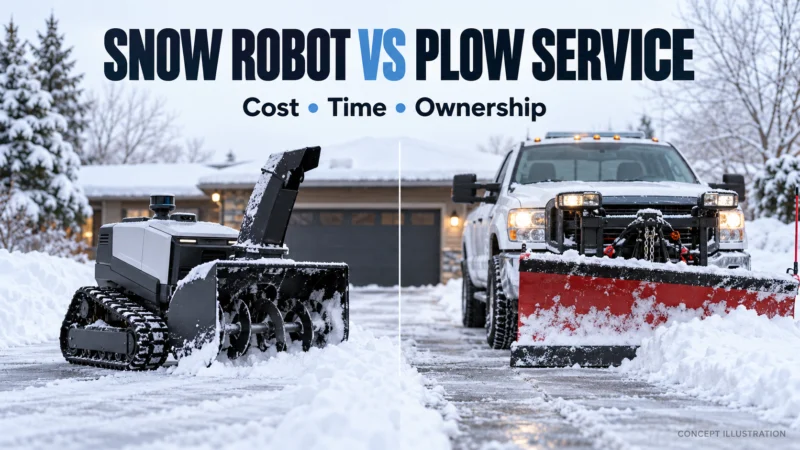
Rebuild the current snow-service bill
Gather several seasons of invoices or contracts if possible. Record whether payment is per push, per season, per inch of accumulation or tied to a trigger time. List the areas the provider clears: driveway, walkways, steps, parking and the ridge at the public road. Separate salting, ice treatment and snow hauling. A robot that clears only a driveway cannot eliminate an invoice for tasks it does not perform.
Use a low, typical and heavy-snow annual cost rather than selecting the most expensive winter to make payback look fast. If a contractor bundles services, request an itemized price for the work that would remain. Label any estimate clearly.
Test whether the machine fits first
Check the manufacturer’s guidance for the driveway surface, slopes, transitions, dock location and safe discharge areas. Determine whether parked cars, temporary obstructions or public-road exposure affect a mapped route. For Yarbo, its published gravel guidance discourages use on gravel or dirt even while describing mitigations; a gravel driveway may require a retained service. Charging cycles and snow accumulation can also change whether the robot keeps up during a prolonged storm.
Only count a task as replaced when the proposed machine can plausibly perform it under its current published guidance. Keep a backup method in the plan for downtime, storms outside practical capacity and clearing tasks beyond the robot’s coverage.
Build the complete investment
For a first-time Yarbo buyer, use the complete system configuration, not the standalone module. Include required setup, a suitable dock and any necessary property work. Optional accessories, financing costs, taxes and shipping can be entered separately. For an existing owner with a compatible Core, calculate the incremental snow-module and accessory cost. Do not charge the full Core cost twice if another seasonal module also uses it.
Affiliate disclosure: As an Amazon Associate, Yard Robot Lab earns from qualifying purchases through the following Amazon links. For a real-world cost input, compare the current complete Core + snow system with the Snow Blower Gen 2 module alone. Use the first for a new installation and the second only after confirming your existing Core is compatible; enter the actual delivered price rather than a price copied from this article.
Record the product price with its source and date. On September 24, 2026, the live U.S. Yarbo pages showed $5,599 for its Y40/Gen 2 complete snow system and $2,000 for the separately offered module. Promotions and delivery status can change; the worksheet should allow either figure to be replaced with the actual checkout amount.
Estimate annual operating costs
Enter shear pins and other consumables, maintenance, electricity, possible service, and a backup snow-removal allowance. Battery aging and major repairs are uncertain; model them as editable scenarios rather than pretending they cost nothing or happen on a universal schedule. If retaining partial contractor service, include that annual bill. Keep convenience and peace of mind as qualitative benefits unless the owner assigns a personal value explicitly.
Simple payback with visible assumptions
Let annual service avoided be only the contractor work that the robot can replace. Let new annual cost include robot maintenance, electricity, continuing service and backup clearing. Then:
Annual net saving = annual service avoided − new annual cost
Simple payback period = complete up-front investment ÷ annual net saving
If annual net saving is zero or negative, the result is “no simple payback under these inputs.” This calculation does not establish reliability, useful life, financing cost, resale value or an investment return. A detailed estimate can add those variables openly. No field should arrive with an invented local contractor price; a dated model price imported from a model page must remain editable.
Run three winters
Test a mild, typical and heavy winter using the same equipment cost but different service and backup expenses. Note when the machine might require multiple clearing-and-charging cycles and whether snow can be placed safely after repeated passes. If one heavy storm still requires a contractor, the cost belongs in that scenario. Show how the estimated payback changes instead of presenting one favorable number as a certainty.
Interpret the result
A robot may provide regular clearing and save scheduling effort even if simple cash payback is long. Conversely, a favorable calculation cannot make a machine suitable for loose gravel, an unsafe discharge direction or an incompatible route. Use the property-fit assessment alongside the cost estimate.
See YRL’s calculator page, Yarbo ownership guide, package-contents guide and gravel warning to fill in the machine-specific inputs.
Separate convenience from billable savings
A machine can improve the experience of finding a path cleared in the morning even when a contractor still handles major storms. That benefit is real to the owner, but it is not the same as a canceled invoice. Start with last winter’s bills and mark which visits the machine could plausibly replace. If a contract has a minimum seasonal charge, a robotic system may reduce no billed visits until the agreement changes. Ask the provider whether partial service, emergency response or end-of-driveway clearing is available and what it costs.
A stress test for the worksheet
Run the calculation with a light winter, an average winter and a heavy winter using the property’s own service records. Keep the equipment price and required installation in each scenario; vary only assumptions that actually change, such as visits replaced, power use and backup calls. Add a repair allowance as an editable input rather than treating an absence of public failure data as proof of zero repairs. If payback appears only in the heavy-snow case, label it a weather-sensitive estimate.
Check what happens if ownership ends earlier than expected or the house is sold. A residual value may offset cost, but use a supported resale estimate or leave it blank. The result should show annual cash difference as well as years to simple payback. When annual savings are zero or negative, do not display a positive break-even date. A buyer can still value convenience, but the calculator should make that choice visible.
In summary: Start with the work actually replaced and the cost of a complete usable configuration. Leave every uncertain input visible and editable. A calculated payback is a planning scenario, not a promise that a robot will replace a contractor on every property or in every storm.
Manufacturer inputs to recheck: Yarbo complete-system listing, module-only listing and gravel safety guidance. The payback formula and scenarios are YRL’s editorial method, not manufacturer claims.