Robot Mowers for Seniors and People With Limited Mobility: What to Check Before Buying
· David
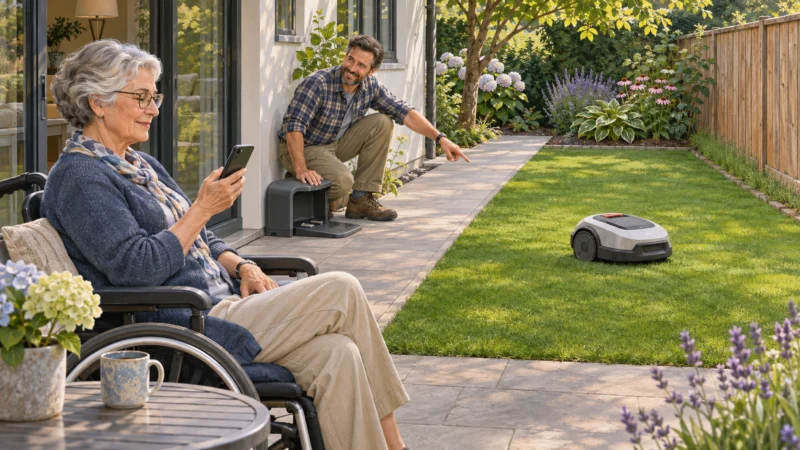
A robot mower can take routine cutting off your schedule, whether you are fully mobile, managing a disability, or simply want less weekly yard work. It does not automatically make every part of lawn care hands-free. Installation, trimming, maintenance, software alerts, and retrieving a stopped mower can still require time or physical help.
The useful question is not whether you are old enough or disabled enough to benefit. It is whether the machine fits your lawn, your preferences, and the work you are willing or able to keep doing. A mower that saves an hour every week can be worthwhile for a healthy older homeowner; someone with limited balance may need a different plan for a machine that stops on a slope.
This guide walks through the whole mowing and ownership job so you can decide whether a robot mower, a lawn service, or a combination fits.
Original editorial illustration. The equipment and setting are generic, not a product photo or tested installation. Follow the selected model’s manual for supervision, placement, clearances, and safe operation.
Affiliate disclosure: Yard Robot Lab may earn a commission from purchases through paid links at no additional cost to you. Product links are research starting points, not accessibility certifications or hands-on recommendations.
The short answer
A robot mower may reduce the effort and time spent on routine mowing on a suitable property. Before buying, make sure there is a realistic plan for the work it may leave behind:
- Installation, mapping, and charging-station setup
- Grass along fences, borders, and other areas the mower cannot reach
- Alerts, interruptions, and safely recovering a stopped machine
- Cleaning, blade changes, seasonal storage, and service
- The cost and availability of help, if you want it
If those tasks are manageable for you—or someone you choose to hire or ask for help—the mower may be a good convenience purchase. If the remaining work would be difficult to arrange, compare the full cost with a lawn service that handles the complete job.
What a robot mower can take off your plate
On a lawn it can navigate safely, an autonomous mower can handle recurring grass cutting and return to its charging station according to its setup. That can mean fewer hours pushing a conventional mower and less time walking the property. If your current routine involves bagging clippings, a robot mower that mulches can also reduce the lifting and emptying involved; check how the exact model handles clippings and whether that suits your yard. The amount of help it provides depends on the model, installation, lawn layout, and your expectations for the finished edges.
People choose robot mowers for different reasons. A fully mobile homeowner may value free time, a predictable lawn, or avoiding a weekly chore. Someone with arthritis, balance concerns, limited stamina, or another disability may value avoiding specific movements. Neither group should assume the mower eliminates every yard task.
If you are an older homeowner who is not disabled
Age by itself does not tell you whether a robot mower is a good fit. You may be active, comfortable with tools and apps, and able to handle all the setup and maintenance. In that case, judge the mower as a time-saving purchase: compare its price and upkeep with the hours of mowing you expect to avoid, and check that its cut and appearance meet your standards.
You may also be planning ahead. Consider whether you would still be comfortable doing the installation, lifting or moving the unit, cleaning it, and managing a fault several years from now. That is future planning, not an assumption that your current abilities are limited. A reliable service option or a model with convenient dealer support can add flexibility without making help a requirement today.
Before committing, try the actual app and controls. Check whether setup feels clear, alerts are easy to understand, and the mower gives you the finish you want. If you prefer not to manage connected devices, ask whether routine operation depends on an app, internet connection, or ongoing troubleshooting. Requirements vary by model and configuration.
If you have limited mobility or a disability
Start with the movements that are hard for you—not a general label. Is it walking across the lawn, standing for long periods, bending, gripping small parts, lifting, working on a slope, or going outdoors during bad weather? A mower that removes one difficult task may still leave another that matters more.
Remote control and autonomous operation are different. Remote control can reduce walking behind equipment, but it still requires someone to steer and supervise. An app does not prove that a product can be safely left unattended. Read the instructions for the exact model and software. Yarbo’s published safety guidance, for example, calls for visual supervision and an authorized, trained person to supervise operation; verify the current requirements for the system you are considering. [1]
After an injury, or if mowing feels unsteady
Conventional grass cutting can involve pushing and turning equipment, walking over uneven ground, working on slopes, and lifting clippings. For an older person recovering from an injury—or someone who has fallen while doing yard work or worries about falling—a robot mower may spare them some of those routine demands by handling the regular cutting. It can reduce the time they personally spend walking behind a mower or crossing the lawn for that task.
That is a possible workload and exposure benefit, not a promise that a robot prevents falls or injuries. Setup, cleaning, alerts, and retrieving a stopped mower can still require physical effort. If the mower stops where you cannot safely reach it, do not make a risky trip across a slope or wet lawn; arrange in advance for a helper or service to respond.
Less time in the grass may reduce some stinging-insect exposure
Walking or pushing a mower through a lawn can bring a person near ground-nesting yellowjackets or other stinging insects. Penn State Extension notes that eastern yellowjackets can nest in mowed lawns and that people can be stung when they contact vegetation or bees in the grass. [5] If a robot takes over routine cutting, you may spend less time personally in the lawn during mowing. That is a limited way to reduce exposure, not protection from stings: the mower can still operate near insect activity, and you may need to approach it if it stops.
Do not send a mower through a known active nest area or approach a nest to recover a machine. Pause mowing in that area and get advice from a qualified pest professional, especially if anyone at home has a serious sting allergy. A robot does not identify or remove nests.
Check the whole property and the work left behind
Edges and narrow areas
Many robot mowers leave some grass near walls, fences, posts, trees, raised beds, and other obstacles because the cutting system cannot reach right up to them. Some models have edge-cutting features that reduce the leftover strip, but the result depends on the mower, boundary, installation, and lawn shape. Husqvarna notes that some installations may still need trimming and that fragmented lawn sections can require manually moving a mower between areas. [2][3]
Ask for a demonstration of the exact model along the kind of edge you have. If the result still needs a string trimmer, decide who will do that work and how often. A small remaining chore can be unimportant to one buyer and the main obstacle for another.
Passages, gates, and separate lawn sections
Walk the full route the mower would need to cover. Narrow passages, steps, steep or uneven ground, closed gates, and separated lawn patches can affect whether it can reach every section. Ask the seller to explain how the exact model handles your layout and what it cannot mow. Do not rely on the advertised lawn area alone; usable route and boundaries matter too.
Charging station and installation
Charging is automatic once a system is properly installed, but the initial setup may involve carrying equipment, preparing a level base, locating power, positioning a reference station, routing approved cables, and mapping the yard. Exact needs vary. Husqvarna’s placement guidance, for instance, calls for a level base and suitable approach space; follow the manual for the model and region you are buying. [4]
Ask what installation includes and request the price in writing. Have the installer demonstrate the mower leaving and returning to its dock, confirm charging, explain the alerts, and identify who to contact if charging fails. If the system needs a new outdoor outlet or a change to fixed wiring, include a qualified electrician in the plan. Keep cables and walking or mobility-aid routes arranged according to the manufacturer’s instructions; do not improvise a route across an entrance.
Stops, alerts, and recovery
Obstacle detection can reduce interruptions, but it does not mean a mower will never stop or need attention. Consider where it might get stuck: a distant slope, a muddy patch, or a place that is difficult to reach. Ask what alerts look like, whether routine problems can be diagnosed remotely, how the manual says to move or shut down the unit, and who can respond if you cannot reach it safely.
Do not make a hurried walk over wet or slippery ground the backup plan. If someone else will help, agree in advance who is available and what they will do.
Cleaning, blades, and seasonal storage
Owners may need to clean the mower, inspect it, replace blades, store it for winter, or arrange service. These tasks can involve bending, kneeling, gripping small fasteners, lifting, or handling a dirty machine. Instructions differ by model; consult the chosen product’s manual and ask a dealer about pickup, delivery, and service availability.
For any owner, those tasks are part of the ownership cost. If you have a condition or limitation that makes a particular task difficult, arrange the help or service before relying on the mower to solve your yard-care problem.
Compare the robot with a service—or combine them
A robot can be one part of a workable plan. For example, it may maintain the open lawn while a landscaper trims the borders a few times a season. Some homeowners may prefer a full-service contractor; others may use a mower and handle the remaining jobs themselves.
Compare costs over the same period. Include the mower, installation, consumables, maintenance, connectivity fees if any, winter storage, and paid help. Then compare that total with a quote for the service you actually want. Ask contractors whether they offer edge-trimming-only visits, complete seasonal care, or dependable service after storms.
A robot is not automatically cheaper, more convenient, or more independent for every property. The best fit is the one that gives you the lawn and workload you want at a total cost you accept.
Before-you-buy checklist
- Walk the full mowing route and identify obstacles, slopes, separate lawn areas, and narrow passages.
- Decide what finish you expect along fences, paths, and garden borders.
- Try the controls and app; confirm which features work without internet, if that matters to you.
- Get a written installation quote and ask what the installer will demonstrate.
- Find out what the mower weighs and how the manual says to move it safely.
- Ask about alerts, support, service, seasonal storage, and parts.
- Decide who will handle trimming, cleaning, blade changes, and recovery if needed.
- Compare the full ownership cost with a lawn service that covers the same work.
Once you have mapped your lawn size, slopes, passages, and expected edge finish, use Yard Robot Lab’s robot mower comparison tool to narrow the model list. It helps compare property fit; it does not rate accessibility or confirm that installation and support are available for your needs.
Common questions
Are robot mowers a good choice for seniors?
They can be, but age alone is not enough to answer. A fully mobile older homeowner may value the time saved; someone else may need to plan around lifting, setup, alerts, or remaining yard work. Check the property and the whole ownership routine.
Can a robot mower help if I have trouble walking or standing?
Potentially. It can reduce routine walking or pushing on a suitable lawn. Check whether installation, edging, maintenance, alerts, and recovery are manageable for you or someone you can reliably arrange.
Will I still need a weed whacker or someone to trim the edges?
Possibly. Some models reduce uncut edges, but obstacles and installation affect the finish. Ask for a demonstration on a similar edge and decide who will handle any remaining strip.
Does a robot mower operate without supervision?
Do not assume that it does. Yarbo’s safety guidelines require an authorized, trained person to supervise operation and say to operate the product only where it can be visually supervised. Requirements vary by manufacturer and model, so check the current manual for the exact mower you are considering. [1]
Should I buy a robot mower instead of hiring a lawn service?
Compare the total cost and tasks covered. A robot may handle recurring open-area mowing, while a service may include edging, cleanup, and help with interruptions. A combination can also work.
Choose by the work you want to remove
A robot mower can be a practical time saver for older homeowners, people with disabilities, and anyone who wants less routine mowing. Its value depends on the lawn, the finish you expect, the work you are comfortable doing, and the support you want available.
Before buying, request a property-specific demonstration, ask for an installation and service quote, and agree who will handle the remaining tasks. If you are ready to compare models, start with Yard Robot Lab’s robot mower comparison tool and model library. If MOVA LiDAX Ultra 1000 is on your shortlist, check current buying options at MOVA. This is a research link, not a recommendation that the mower fits every buyer.
Manufacturer sources
Research checked November 12, 2026. Features, manuals, and policies can change; verify the exact model and configuration before purchase.
- Yarbo safety guidelines
- Husqvarna Automower FAQ
- Husqvarna EdgeCut operation and installation guidance
- Husqvarna charging-station placement and installation guidance
- Penn State Extension: Eastern yellowjacket — ground-nesting behavior and management considerations for lawns.
Leave a Reply